
Sugar Season: What’s the Stephan Curve and how does it affect my teeth?
October 26, 2026

Whether it’s leftover sweets from Trick or Treating, or those mince pies on 3-for-2 in the supermarket, the darker days and colder weather can make snacking all the more appealing. Most of us have heard our dentist advise that sugar should be eaten straight after meals rather than grazed on throughout the day, but what’s the science behind this advice?
First described by Robert Stephan, a dental researcher investigating plaque chemistry in the US in the 1940’s. The Stephan Curve is a graph showing how acidic your teeth become after eating something sugary, and how long it takes them to recover. Each time you eat sugar, the pH level in your mouth drops (i.e. it becomes more acidic). Acid in your mouth attacks the minerals that make up the enamel, the protective layer on the outside of your teeth. However, over time, the pH levels in your mouth will recover as your saliva levels readjust and help the teeth to re-mineralise.
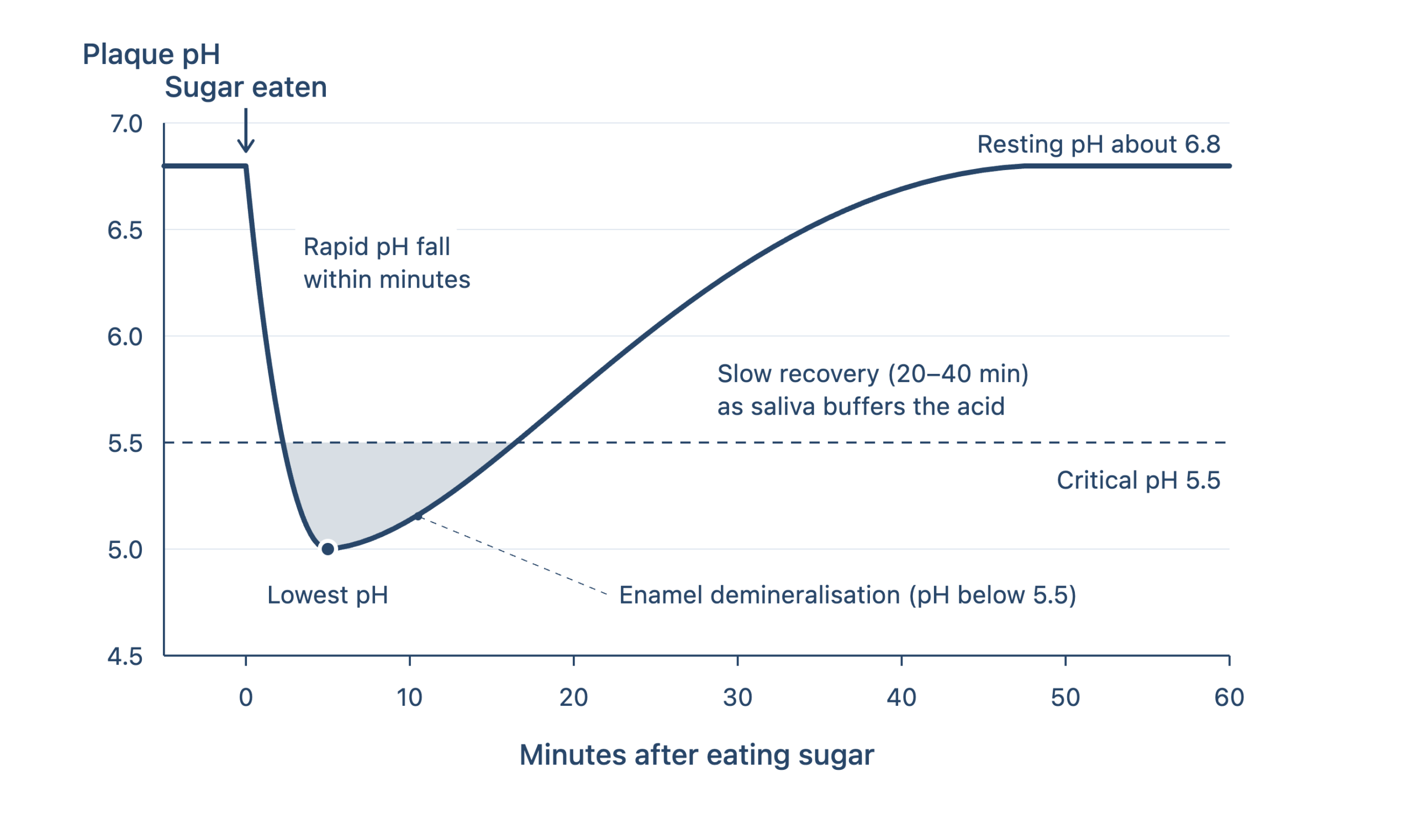
The problems occur when you eat sugar repeatedly over a prolonged period of time, such as grazing on a bag of sweets through the afternoon, or mince pies and sweet festive coffees mid-morning. Your teeth never get a chance to recover and re-mineralise, meaning damage the to enamel accumulates. Once the enamel is weakened, bacteria in your mouth that feed on the sugar can get inside the tooth, causing cavities and decay.
It’s important to ensure that after eating sugary treats, we give our mouths time to recover the pH and help our teeth to re-mineralise. This is why dentists often recommend that if you’re going to eat sugar, you do it after a meal and not in between.
NHS advice also says free sugars should not make up more than 5% of your daily energy intake – that’s no more than 30g a day for adults (roughly 7 sugar cubes). The limits for children are lower; 24g for ages 7-10; 19g for ages 4-6.
This can be hard to achieve at this time of year, but here are some practical takeaways to help minimise the damage.
The Richard Irvin Building, Union Road, North Shields, Tyne & Wear, NE30 1HB
Mon – Thu: 8am – 8pm
Friday: 8am – 3pm
Saturday: 9am – 3pm
Sunday: Closed